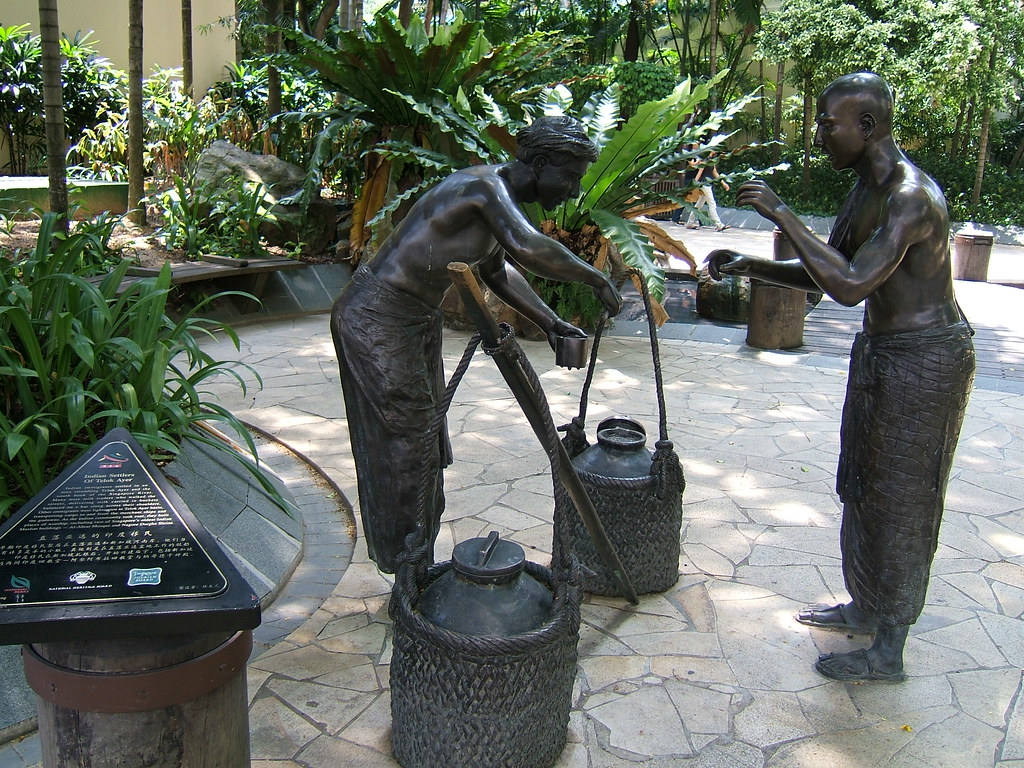
At Telok Ayer Green, you’ll find a life-sized bronze sculpture of an Indian milk vendor selling his milk to a customer. It commemorates the early milkmen and traders who once settled in the area. In fact, nearby Cross Street was nicknamed Palkadai Sadakku in Tamil, meaning “Milkshop Street,” because many milk traders gathered there.
Kreta Ayer district is one of the districts originally designated for Chinese settlers. Its name means “water cart” in Malay — a reference to the bullock carts that, in the 19th and early 20th centuries, transported water from wells at Ann Siang Hill to Chinatown. The Chinese called the area Niu Cher Shui (and its variants in the different dialects), literally “ox-cart water.” Kreta Ayer Road links Neil Road to New Bridge Road, a reminder of its working past.
In the narrow streets beside the Tekka Market you’ll find Buffalo Road and Kerbau Road (kerbau is buffalo in Malay). Belilios Lane and Belilios Road are named after I.R. Belilios, a prominent cattle trader in the 1840s. Further along is Lembu Road (lembu means cow in Malay). These names are markers of the location’s long history as a cattle-trading hub.
The cattle heartland is the Kandang Kerbau district, located where Serangoon, Selegie, Bukit Timah, and Rochor roads meet. It was once home to cattle sheds and grazing grounds — its Malay name literally means “buffalo pens.” This was where early Indian immigrants, many skilled cattle farmers and milkmen, settled because of the lush grasslands and water from the Serangoon River. The area also hosted the original Singapore Sporting Club racecourse, opened in 1843. Popular with Europeans and wealthy Chinese, the racecourse drew more workers and more cattle business to the area. By 1924, the district became known for another reason: the Kandang Kerbau Maternity Hospital, then a free maternity hospital, where generations of Singaporeans were born. The hospital moved to Bukit Timah Road in 1977, but the KK name remains iconic.
Why are so many roads named after cattle and why is it so prominent?
Many references to cattle and cows in Singapore are due to the country’s history as a hub for cattle trading and dairy farming, as well as the cultural and religious significance of the animals to the Indian community. In the 19th and early 20th centuries, the KK area was a centre for the cattle trade, with animals imported from countries like Siam (Thailand) and India to be used for meat, milk, and transportation, with dairy products mainly for the Europeans. Unlike Chinatown and Kampong Glam, Little India was never in the town plan to be set aside for the Indians. It is actually a residential area for the early Europeans, as evident in the many roads named after the Europeans who resided there. The cattle trade boomed in the mid-1800s, together with the growth of the district around the race course. It attracted Indians to come and work and stay in this area.
What about the Dairy Farm?
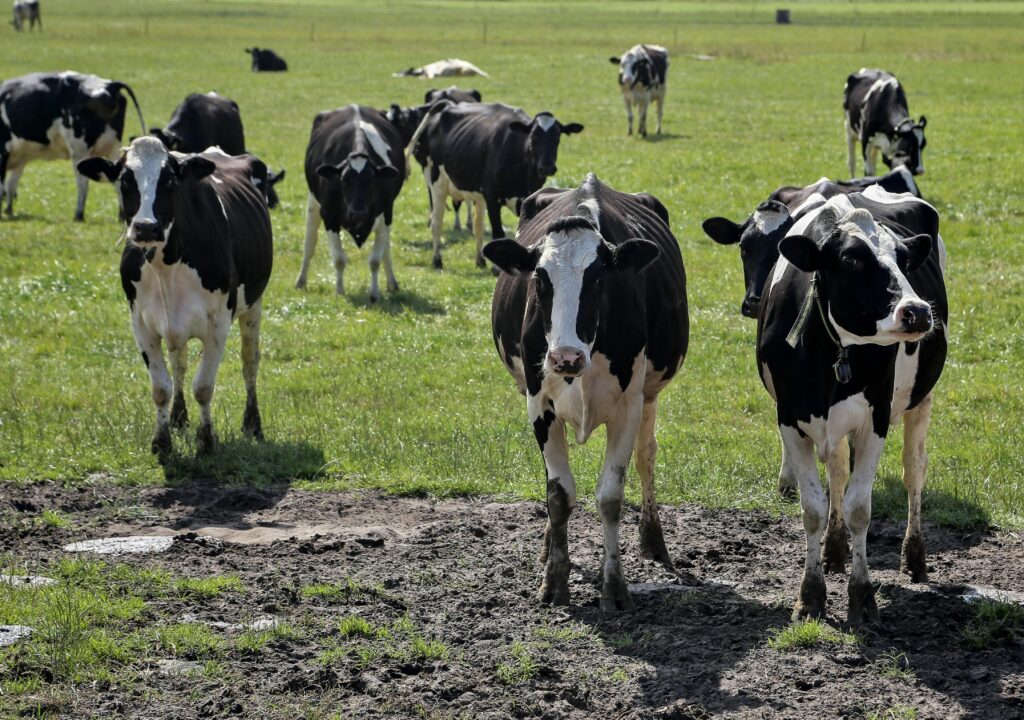
By the early 1900s, the milk from KK was gaining an unfortunate reputation for poor quality and hygiene. Europeans began turning to imported dairy products from Australia — but these had to be frozen during the long voyage. That’s where Cold Storage Company stepped in. Established in 1903 as an importer of chilled and frozen goods, the company ventured into dairy farming in 1932. Using a variety of grass developed in Java by Dutch scientists, they set up the Singapore Dairy Farm at the 9¼-mile mark of Bukit Timah Road (near today’s Rail Mall). They imported Friesian cows from Holland and Australia, enforced strict hygiene standards, and introduced pasteurisation, refrigeration, and modern packaging. The farm became the world’s first tropical farm to rear Friesian cows successfully. Its milk was sold under the Magnolia brand — famously packaged in pyramid-shaped cartons.
At its peak, the farm had about 800 cows. Most of its workers were Indian, trained in modern dairy practices. But by the 1970s, with imports becoming cheaper and easier, the farm ceased operations. In 1976, the Singapore government acquired the land for residential development. Today, there is the Dairy Farm Nature Park and the Wallace Education Centre that repurposes the old dairy building into a public ecological learning place. And there is only one small dairy farm existing today.
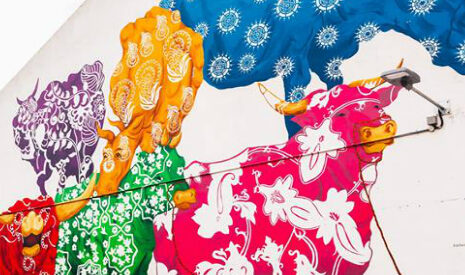
Cattle Murals reflecting the bovine heritage.
Leave a Reply